

Moving to France sounds exciting, right? But before you start packing your bags and dreaming about fresh croissants every morning, there’s one big thing you need to handle first – your French Long Stay visa.
I know the visa process can feel scary. There are so many forms, rules, and documents. But don’t worry. I’ll walk you through every single step in simple words. By the end of this guide, you’ll know exactly what to do.
What Is a French Long Stay Visa?
Understanding the VLS-TS (Visa de Long Séjour)
The French Long Stay visa is also called VLS-TS. That’s short for Visa de Long Séjour Valant Titre de Séjour. I know, it sounds fancy. But here’s what it really means – this visa lets you stay in France for more than 90 days.
Most tourist visas only allow you to visit for three months. But if you want to live, study, or work in France, you need this special long stay visa. It works as both a visa and a residence permit<span style=”font-weight: 400;”>. Once you get it and follow all the rules, you can legally live in France for up to one year.
Think of it like this – a short stay visa is like renting a hotel room for a weekend. A long stay visa is like renting an apartment for the whole year. You get to actually live there, not just visit.
Who Needs a Long Stay Visa for France?
You need this visa if you’re from outside the European Union, European Economic Area, or Switzerland. If you’re from the United States, Canada, Australia, India, China, or most other countries, and you want to stay longer than 90 days – yes, you need this visa.
But some people don’t need it. If you’re from an EU country, you can already live in France without any visa. Same for people from Switzerland, Norway, Iceland, and a few other places.
Students going to French universities, people with job offers, retirees who want to enjoy French life, or anyone joining family members – all these people usually need a long stay visa.
Types of French Long Stay Visas Available
Visitor Visa for Non-Working Expats
The visitor visa is perfect if you just want to live in France without working. Maybe you’re retired. Maybe you have savings. Maybe you work online for companies outside France. This visa is for you.
To get this visa, you must show you have enough money to support yourself. The French government wants to see that you won’t need to work illegally or ask for help. According to research, you need to prove you have at least €1,400 per month for one person, or about €2,100 for a couple.
This visitor visa also needs you to have health insurance that covers you in France. No work allowed with this visa – that’s the main rule.
Work and Professional Visas
If you have a job offer from a French employer, you need a work visa. This is different from the visitor visa. Your employer must help you get this visa. They need to prove to French authorities that they really need you for the job.
The work visa process takes longer because your employer has to get something called an autorisation de travail first. That’s a work permit. Only after they get that permission can you apply for your visa.
There are also special visas for talented people. The talent passport is for highly skilled workers in fields like technology, science, or business. Each visa type has its own rules, but they all let you work legally in France.
Essential Requirements for Your Application
Financial Requirements You Must Meet
Money matters a lot for this visa. France wants to make sure you can take care of yourself. You can’t just say “I have money.” You have to prove it with real documents.
For the visitor visa, bank statements from the last three months are usually required. If you’re retired, pension papers work too. Some people show savings in their accounts. Others show regular income from investments.
The amount changes based on where you’ll live. Paris costs more than a small town in the countryside. But as a basic rule, plan to show at least €1,400 per month. That’s about $1,500 in US dollars.
I learned this the hard way when I helped my friend apply. He only showed two months of bank statements instead of three. His application got delayed by two weeks. Don’t make that mistake.
Health Insurance and Coverage Rules
Health insurance is not optional – it’s required. And not just any insurance. It must be proper long-term insurance, not travel insurance you buy for vacations.
Your insurance needs to cover medical care in France for your whole stay. Emergency care, doctor visits, hospital stays – everything. According to information from the French Embassy, the minimum coverage should be at least €30,000.
You can buy private health insurance from companies that work in France. Later, after you live in France for a few months and validate your visa, you might be able to join the French public healthcare system called PUMa.
Documents You Need to Prepare
Mandatory Documents for All Applicants
Getting your documents ready is the most important part. Missing even one small paper can cause big problems. Here’s what everyone needs:
First, your passport. It must be valid for at least three months after your visa ends. It should have at least two empty pages. Check your passport right now – is it old? Does it expire soon? If yes, renew it before you apply.
You need passport photos that meet French rules. They must be recent, with a white background, and show your full face clearly. Most photo shops know the exact size needed.
The application form is called a Cerfa form. You fill this out online on the France-Visas website. Print it out after you complete it. Don’t have the word “DRAFT” on it – that means it’s not finished.
Proof of accommodation is also required. This could be a rental contract if you’re renting. Or a hotel booking. Or a letter from someone who will host you in France.
Additional Papers Based on Your Visa Type
Different visas need different extra documents. For a work visa, you need your employment contract signed by your French employer. You also need the work permit that your employer got for you.
For a student visa, bring your acceptance letter from the French school or university. Also, bring proof that you can pay for school and living costs. Students need to show at least €615 per month according to the official Campus France guidelines.
For family reunion visas, you need documents proving your relationship. Marriage certificates for spouses. Birth certificates for children. Sometimes you need DNA tests if documents aren’t clear.
All documents must be in French or English. If they’re in another language, you must get them translated by a certified translator. Keep both the original and the translation.
Step-by-Step Application Process
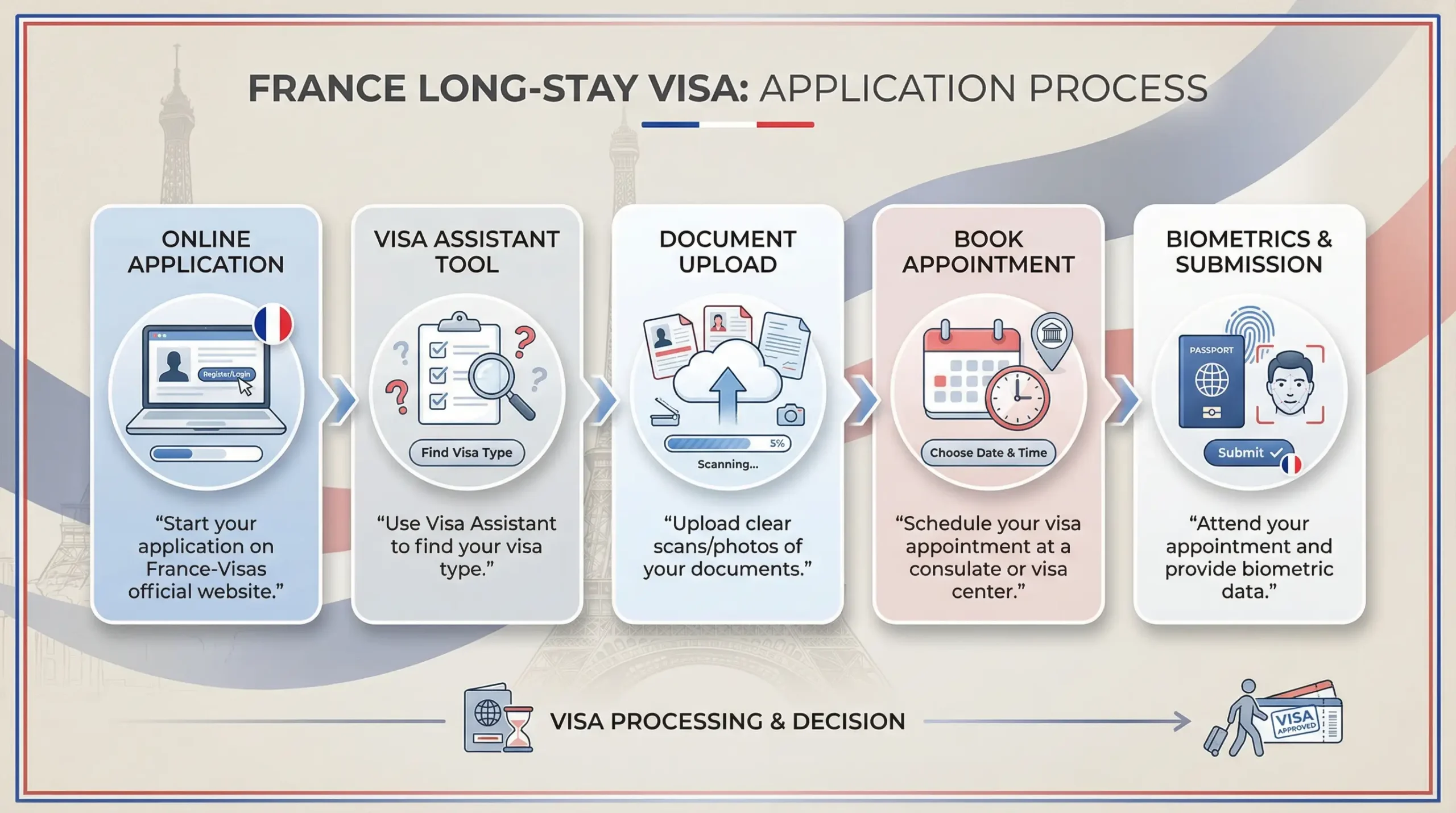
Starting Your Online Application on France-Visas
Ready to actually apply? Good. Here’s how it works, step by step.
Go to the France-Visas website. That’s the official government site. Don’t use random visa agency websites that charge extra fees. Create your personal account there.
The website has a tool called “Visa Assistant.” Use it first. It asks you questions about your situation and tells you exactly which visa type you need. Answer honestly.
After that, fill out the online application form. Take your time. Read each question carefully. Wrong information can cause delays or rejection.
Upload clear scans or photos of all your documents. Make sure they’re not blurry. At the end, you’ll get a confirmation with a reference number. Print this out. You’ll need it for your appointment.
Booking and Attending Your Visa Appointment
You can’t just mail your documents. You have to go to an appointment in person. After finishing your online form, you’ll book this appointment at a French consulate, embassy, or visa center like VFS Global or TLScontact.
Book as early as you can. Popular consulates get very busy. You might wait weeks for an appointment if you’re slow.
On appointment day, bring everything. Your passport, the printed application form, all original documents, and copies too. Dress nicely – first impressions matter.
They’ll take your biometric data – that means fingerprints and a photo. They’ll also ask you a few questions. Stay calm. Answer honestly. The whole thing usually takes 30 minutes to an hour.
You pay the visa fee during this appointment. Some consulates only take cash, others take cards. Check ahead of time.
After You Receive Your Visa
Validating Your Visa Within 3 Months
Congratulations! You got your visa. But wait – you’re not done yet. This part is super important, and many people forget about it.
Within three months after arriving in France, you must validate your visa online. This is not optional. If you don’t do it, your visa might become invalid.
Go to the official website: administration-etrangers-en-france.interieur.gouv.fr. Enter your visa information. Give your French address and date of arrival. Pay the validation fee of €200.
You’ll receive two emails. One with your login information. Another confirming your visa is validated. Save these emails. Print them out. Keep them safe. You might need to show them later.
After validation, your long stay visa becomes a full residence permit. Now you can legally live in France for the whole year.
Registering with Local Authorities
Some visa types require extra steps after you arrive. If you have certain visas, you might need to visit OFII – that’s the French Office of Immigration and Integration.
They might ask you to do a medical check-up. They might give you a welcome session about living in France. Check your visa papers to see if this applies to you.
You might also need to register at your local town hall or prefecture. This depends on where you live. Ask your landlord or neighbors about local rules.
Common Mistakes That Lead to Visa Rejection
Documentation Errors to Avoid
Visa rejection hurts. You lose time, money, and energy. Most rejections happen because of simple mistakes you can easily avoid.
The biggest mistake? Missing documents. You must bring every single paper on the required list. Don’t think “maybe they won’t notice.” They will notice. They will reject your application.
Another mistake – expired documents. Check all your papers. Is your passport about to expire? Are your bank statements old? Everything must be current and valid.
Wrong information on forms is also bad. If your form says you’re staying in Paris but your accommodation proof shows Lyon – that’s a red flag. Double-check everything matches.
Blurry or unclear photocopies cause problems too. Make sure all your copies are clean and easy to read.
Financial Proof Problems
Many people get rejected because their financial proof isn’t strong enough. Just showing one month of bank statements won’t work. You need at least three months.
Your bank balance can’t be too low. If you’re applying for a visitor visa and your account only has €2,000, that won’t be enough. Remember – you need to prove €1,400 per month.
Some people deposit a big amount of money into their account right before applying. That looks suspicious. The French consulate wants to see steady, regular income or savings – not sudden deposits.
Show income from multiple sources if you can. Pension + savings is better than just pension. Job contract + savings is stronger than just one of them.
Living in France with Your Long Stay Visa
Your Rights and Responsibilities
Once you have your validated long stay visa, you can enjoy many benefits. You can live legally anywhere in France for up to one year. You can open a French bank account. You can rent or buy property.
After three months in France, you might be able to register for PUMa – that’s the public healthcare system. This gives you the same health benefits as French citizens.
You can travel freely in the Schengen Area – that includes 27 countries in Europe. You can stay up to 90 days in other Schengen countries within any 180-day period.
But you also have responsibilities. You must respect French law. If your visa says “no work allowed,” don’t work. If you need to register somewhere, do it on time.
Keep all your documents safe. Your visa, passport, registration papers, insurance – keep copies of everything. You might need to show them to the police or officials.
Can You Work on a Long Stay Visa?
This is one of the most common questions I hear. The answer depends on your visa type.
- Visitor visas don’t allow work in France. You can’t get a job with a French company. You can’t start a business selling to French customers. But you can work remotely for companies outside France – that’s usually okay.
- Work visas obviously allow work. But only for the job and employer mentioned in your visa. If you want to change jobs, you need to update your visa.
- Student visas allow part-time work up to 964 hours per year. That’s about 20 hours per week. This helps students earn extra money while studying.
If you try to work without permission, you could face big problems. Fines, deportation, or future visa bans. It’s not worth the risk. Follow your visa rules exactly.
Renewing or Extending Your Visa
When to Apply for Renewal
Your long stay visa usually lasts one year. What if you want to stay longer? You need to think about renewal or extension.
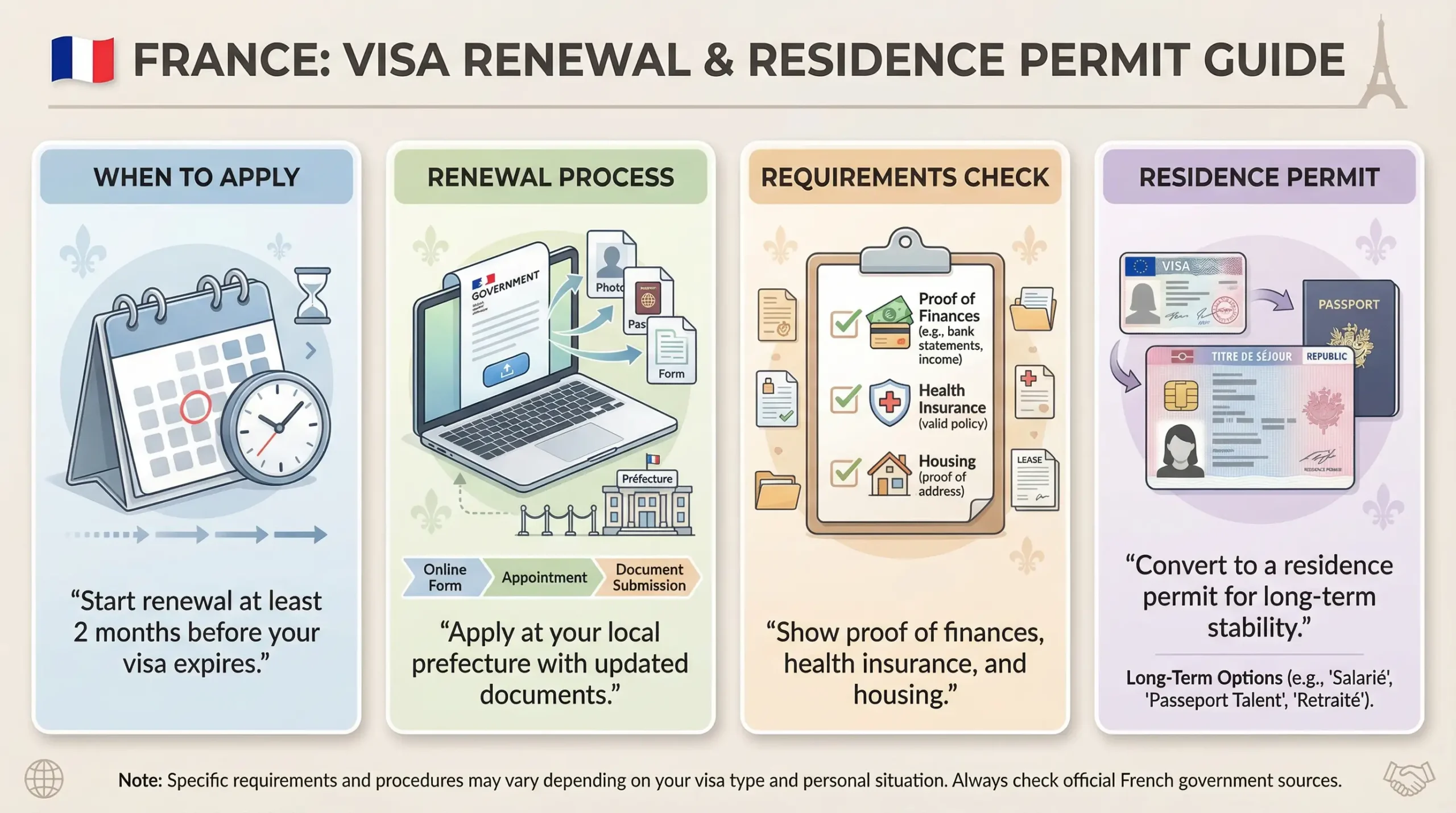
Don’t wait until the last minute. Start the renewal process at least two months before your visa expires. Some people wait too long and then can’t stay legally.
To renew, you apply at your local prefecture in France – not at a consulate in your home country. The process is mostly online now through the same government website you used for validation.
You’ll need to show that you still meet all the requirements. Still have enough money? Still have health insurance? Still have a place to live? Prepare updated documents proving all this.
Converting to a Residence Permit
Many people don’t just want to renew the same visa. They want something more permanent – a residence permit or carte de séjour.
If you had a long stay visa and followed all the rules for one year, you might qualify for a residence permit. This is better because it’s more stable. It shows you’re a proper resident, not just a long-term visitor.
The residence permit can last one to four years, depending on your type. It’s renewable too. After living legally in France for several years, you might even qualify for permanent residency or citizenship.
The conversion process varies by visa type and situation. A work visa holder might convert easier than a visitor visa holder. Check with your local prefecture about your specific options.
Conclusion
Getting a French Long Stay visa takes effort, but it’s totally doable if you follow the steps carefully. Start by understanding which visa type fits your situation. Gather all your documents properly – don’t skip anything. Fill out your online application accurately on the France-Visas website. Attend your appointment with confidence.
After you receive your visa, remember to validate it within three months of arriving in France. Pay the €200 fee online and keep your confirmation emails safe. Follow all the rules of your visa, especially about working.
The whole process usually takes four to eight weeks from application to approval. Yes, there are fees – the €99 application fee plus other costs for translations, insurance, and validation. But these costs are worth it when you get to live in beautiful France legally.
Don’t let the paperwork scare you. Thousands of people successfully get this visa every year. You can too. Contact us for the most reliable service. Just be organized, honest, and patient. Soon you’ll be enjoying fresh bread from the local bakery and saying “bonjour” to your French neighbors. Good luck with your application!
Frequently Asked Questions
How long does it take to get a French Long Stay visa?
The processing time usually takes between 15 to 30 days after your appointment. However, during busy seasons like summer, it might take up to six weeks. That’s why you should apply at least three months before your planned travel date. Some consulates are faster than others, so check with your local French consulate about their typical waiting times.
Can I travel to other European countries with this visa?
Yes, you can! Once your French Long Stay visa is validated, it works like a Schengen visa for traveling. You can visit other Schengen Area countries for up to 90 days within any 180-day period. This includes popular destinations like Spain, Italy, Germany, and 24 other countries. Just make sure France remains your main country of residence.
What happens if my visa application is rejected?
If your visa gets rejected, you’ll receive a written explanation telling you why. You have the right to appeal this decision within two months. You can either send an administrative request for review or take the case to an administrative court. The rejection letter will explain your exact options. In many cases, people reapply after fixing the problems that caused rejection.
Do I need to speak French to apply?
No, you don’t need to speak French to apply for the visa. The application can be done in English at most consulates. Your documents can be in English too (though documents in other languages need translation to French or English). However, learning some basic French before moving will make your life much easier once you arrive in France.
Can I bring my family members with me?
Yes, family members can come with you, but they need their own visas. Your spouse and children can apply for family reunion visas based on your main visa. They’ll need to submit their own applications with proof of relationship (marriage certificate, birth certificates) and show they’re financially supported by you. Each family member pays their own visa fee too.