
On this page
Updated 20 November 2026: on 13 November 2026 Prime Minister Terrance Drew announced that St Kitts and Nevis will wind down its Citizenship by Investment Programme. The final date for new applications will be announced once a timeline is agreed with the European Union, and applications continue under the current rules until then. The government says the decision has no immediate effect on existing citizens or their travel. The SISC is US$250,000 for a family of up to four, approved real estate starts at US$325,000 (US$600,000 for a private home), the CIU aims to give a first decision within 120 to 180 days of acknowledging a file, and the main applicant must attend an interview.
For more than four decades, the Federation of St. Kitts and Nevis has offered what many call the gold standard in citizenship-by-investment (CBI). Launched in 1984, it was once a niche pathway for Caribbean-based investors. Today, it stands as one of the most respected and established second-citizenship programs in the world.
In 2026 the programme still attracts entrepreneurs, families and investors who want a second citizenship, more travel options and somewhere to hold part of their wealth. It is also on a countdown now: the government has said it will close the programme once a timeline is agreed with the EU (see the update above).
Why St. Kitts & Nevis Remains the Gold Standard
St. Kitts & Nevis built its name on a long track record, which matters when you are investing serious money and planning your family’s future. These are the reasons investors have chosen it, although the programme is now being wound down:
- Credibility – It’s the longest-running CBI program in the world.
- Strong government oversight – Managed by an independent Citizenship by Investment Unit (CIU), now a statutory body under the Citizenship by Investment Unit Act 2024.
- Processing time – The CIU aims to give a first decision within 120 to 180 days of acknowledging a complete file. The paid Accelerated Application Process (AAP) is no longer offered.
- Trusted reputation – Due diligence is done through global firms, ensuring your new citizenship is respected in Europe and the UK.
That record is why it has long been one of the leading Caribbean citizenship options.
Investment Options
You don’t have to buy real estate unless you want to. Whether you’re going solo or applying with your family, here’s a breakdown of what’s available in 2026:
| Route | Minimum Contribution | Description | Holding Period |
|---|---|---|---|
| Sustainable Island State Contribution (SISC) | USD 250,000 (main applicant or family of up to 4) | Non-refundable donation supporting sustainability | – |
| Real Estate Option | USD 325,000 | Buy in an approved hotel, resort, or villa project | 7 years |
| Private Home Option | USD 600,000 | Buy a single-family home | 7 years |
| Public Benefit Option | USD 250,000 (main applicant or family of up to 4) | Contribute to government-approved projects | – |
Note: Processing fees and due diligence costs are separate and apply on top of your investment.
Visa-Free Mobility in 2026
Travel Freedom Without the Paperwork
One of the biggest advantages of the St. Kitts & Nevis passport is how much freedom it gives you to travel — without waiting in embassy lines or stressing over visa appointments. As of 2026, passport holders enjoy visa-free or visa-on-arrival access to about 157 destinations. That includes some of the world’s most important business and travel hubs across Europe, Asia, the Americas, and parts of the Middle East and Africa.
Unlocked Access to Europe
If you’ve ever had a deal or event delayed because of visa approvals, this benefit alone is a game-changer. With this passport, you can freely enter all 29 Schengen Area countries, plus the United Kingdom, which asks for an online ETA before you travel. Ireland, however, has required a visa from St Kitts and Nevis nationals since 15 June 2026. Whether you’re attending a conference in Berlin, exploring markets in Amsterdam, or closing deals in London, you do not need to apply for a visa in advance for a short stay, as long as the Schengen visa waiver for St Kitts and Nevis stays in place. That is a real advantage for entrepreneurs, investors, and even students with European interests.
Caribbean and Latin American Reach
Within the CARICOM bloc, you’ll be welcomed across member states, making regional travel effortless. You also gain access to dynamic South American markets like Brazil (via eVisa), Chile, and Peru. Whether you’re looking for investment opportunities or just a beachside break, this coverage makes moving around the hemisphere fast and stress-free.
Middle East and Africa Entry Simplified
While many Western passports still face hurdles in some African and Middle Eastern countries, St. Kitts & Nevis nationals enjoy smoother access to places like Seychelles, Mauritius, and Jordan (via eVisa). These regions are growing hubs for tourism, tech, and renewable energy investments. Having a passport that welcomes you there without extra hoops is a hidden asset.
Comparable to European Tier 2 Passports
Overall, the mobility power of a St. Kitts & Nevis passport now rivals — and in some cases exceeds — many mid-tier European citizenships. It’s especially popular with remote workers, startups, and frequent flyers who can’t afford to lose time to red tape. For people seeking a second citizenship, this passport offers strong travel convenience.
Fiscal and Lifestyle Advantages
Say Goodbye to Global Tax Headaches
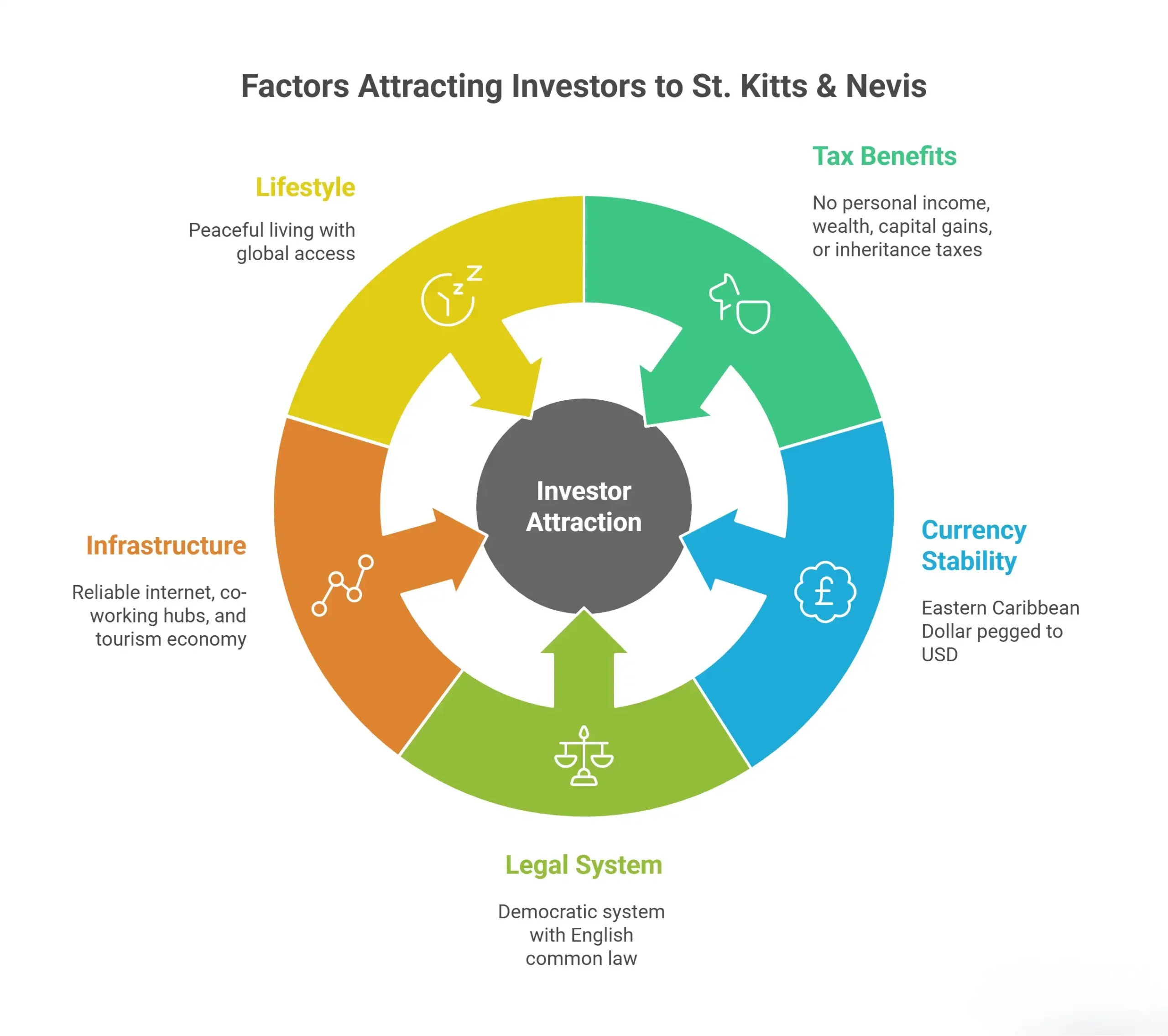
When people talk about the real value of St. Kitts & Nevis citizenship, they often mention travel. But the tax and lifestyle benefits are just as powerful — especially for high-income earners or those with global holdings. The country imposes no personal income tax, meaning your global earnings stay intact. There are also no wealth taxes, no capital gains taxes, and no inheritance taxes. Keep in mind that a second passport does not change where you pay tax on its own. That depends on where you are tax resident, so take tax advice before planning around these rules.
Currency Stability and Business Simplicity
The local currency, the Eastern Caribbean Dollar (XCD), is pegged to the US Dollar at a fixed rate of 1 XCD = 0.37 USD. This peg has held strong for decades, creating a level of economic predictability that’s rare in small island states. For investors, this means smoother banking, clearer pricing, and no big currency shocks. It’s a quiet, underrated benefit — especially for those moving funds internationally.
Safe, Peaceful, and English-Speaking
The country operates under a democratic system based on English common law, and English is the official language. That makes everything — from opening a bank account to registering property — much easier for international investors.
Built for Remote Work and Family Life
If you’re planning to relocate or even live part-time on the island, you’ll find the infrastructure is already there. The country offers reliable internet, growing co-working hubs, and a strong tourism economy that supports digital nomads and entrepreneurs. There’s also access to modern healthcare, international schools, and a fast-growing market for wellness and real estate retreats.
Calm Living Meets Global Access
Many investors are drawn to St. Kitts & Nevis not just for tax benefits, but for the lifestyle. It’s a peaceful, well-connected, and underrated Caribbean base, ideal for anyone seeking balance between financial freedom and quality of life. Whether you want a tranquil place to retire or a sunny second home with business perks, this country checks every box.
Step-by-Step Application Process
Here’s how the process works from start to finish:
- Engage a Licensed Agent – Only CIU-authorised agents can submit your application.
- Choose Your Investment Route – Pick between SISC, real estate, or another approved path.
- Prepare Documentation – Includes police reports, medicals, financials, and proof of funds.
- Due Diligence Screening – Background checks by international firms.
- Approval in Principle – Typically within 120–180 days of the CIU acknowledging your file (compare Dominica’s processing timeline).
- Make Final Payment & Take Oath – You’ll get your citizenship certificate and passport.
The main applicant must attend an interview, which can be held online, but there is no language test, and no residency requirement—before or after approval.
Economic Impact and Transparency
According to the IMF’s 2025 Article IV report, the country faces fiscal pressure and notes lower CBI contributions as a factor. In 2025, around 20% of government revenue comes from the CBI program. These funds support:
- Climate-resilient housing
- Renewable energy projects
All reports are audited by Ernst & Young, building even more international trust.
According to the International Monetary Fund’s 2025 Article IV Consultation Report, St. Kitts & Nevis continues to strengthen fiscal transparency and governance under its Citizenship by Investment (CBI) Program, ensuring that revenues are managed responsibly and reforms remain sustainable.
Expert Insight
“The value of a St. Kitts passport lies in its consistency. Governments change, markets fluctuate, but this program has delivered for 40 years.”
Charlie Maggi, CEO of The Open World
Outlook for 2026 and Beyond
The biggest change is the wind-down. In June 2026 the European Commission invited St Kitts and Nevis to phase out the programme, under EU rules in force since the end of 2025 that let the bloc treat investor citizenship as a ground for suspending visa-free travel to the Schengen area. In a national address on 13 November 2026, Prime Minister Drew confirmed the decision to wind the programme down and said the final date for new applications will be announced once it is agreed with the EU.
During the transition, applications continue under the current investment thresholds and vetting rules, and the government says the decision has no immediate effect on existing citizens or their travel. If you are weighing this programme now, plan for the window to close before you are ready.
Ready to Start?
Ask our advisers whether St Kitts & Nevis fits your family.
Final Thoughts
St. Kitts & Nevis has the longest track record of any citizenship-by-investment programme, a clear menu of investment options and no residence requirement. The catch now is timing. With the wind-down announced in November 2026, check how long applications will stay open, and compare a residence-by-investment route such as residency in France.
FAQs – Common Questions in 2026
Is dual citizenship allowed?
Yes, St. Kitts & Nevis allows dual citizenship without notifying your original country, unless your home country requires it.
Can I include parents or siblings in my application?
Parents of you or your spouse can be included if they are 55 or over and live with you and are fully supported by you. Siblings are not on the current list of eligible dependants.
Is my SISC contribution refundable?
No. It’s a non-refundable donation. However, real estate can be sold after 7 years.
Are there any risks to be aware of?
Yes, like:
- Limited liquidity in small island real estate
- Non-refundable costs
- Policy changes due to OECD or EU pressure, including EU moves to suspend visa-free travel for countries that sell citizenship. In November 2026 the government announced that the programme will be wound down
Working with trusted partners helps reduce these risks.
Do I need to visit or live in St. Kitts?
Nope. There’s no travel or residency requirement, before or after approval. Everything is handled through your agent.
Related articles

Citizenship & Residency
Dominica CBI Processing Time: How Long Each Stage Takes in 2026

Citizenship & Residency
Latin America Residency by Investment: 4 Routes Compared

Citizenship & Residency